NWABSD Funding Formula

NWABSD Logo


This blog post focuses on the calculation of funding levels for school districts.

The availability of funding sources impact the Norwest Arctic Borough School District’s staffing, educational programs, professional development, and extra-curricular budgets;  therefore, the school district, is not only monitoring and assessing the current budget, it is constantly projecting the following year’s budget.

STATE FUNDING

Why is there a state funding formula?  How does the formula work.  This is just nothing more than a giant algebra formula.  Every dollar counts!

The formula provides foundation funding to objectively distribute state money to districts.

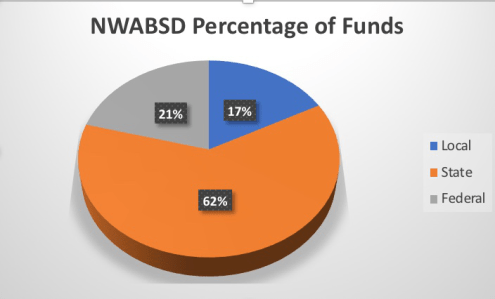
  • The primary funding source for Northwest Arctic Borough School District is the state of Alaska.
  • It generates 62% of the overall budget.
  • This piece of the budget requires extreme attention.
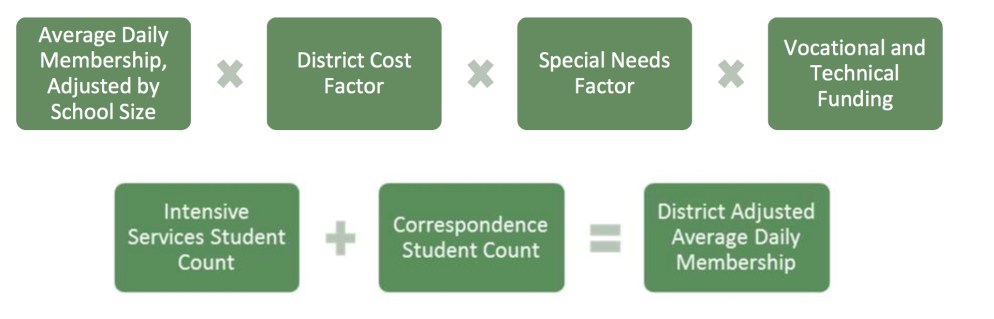
  • The Basic Student Allocation (BSA) formula is made up of six factors.
  1. The Average Daily Membership Adjusted by school size is based on the school size within the district.
  2. The District cost factor is based primarily on geographic location. There are twelve subcomponents for this cost factor.  For example, energy cost, travel of district administrators, maintenance, teachers to schools and transportation cost of goods.
  3. Special Needs Funding is intended to instruction for non-intensive special education, vocational, gifted and talented and bicultural/bilingual education.
  4. The vocational/career education variable increases a district size for additional funding.
  5. Intensive Services involves with an intensive student is counted as 13 students.
  6. Correspondence program entails these students will be calculated at a .9 for each student.
 

asdf


Federal

The federal funding provides 21 percent of the budget.   The federal funding primarily has four subcomponents.- Where is the fourth?

  1. Impact Aid the school district will be sending information pamphlets and survey cards for parents to fill out. Please remember October 19this the deadline. The primary focus of the Impact Aid calculation is based on the number of families that live and work on federal land.
  2. Migrant Ed the amount of student varies it is based on the number of students based in the Fall. We start the school year from the previous year.  This fund helps with extra reading materials, paraprofessionals, Title Funds, and E-Rate.
  3. E-Rate funding is established by the school district requesting reimbursement. For example, internet services. 90% of the cost will be reimbursed to the school district.
  4. Federal Grants, this money is restrictive meaning it can only be used for specific functions, not part of the general budget.


Local Contribution

The Northwest Arctic Borough is requirement of 2.65 mill tax levy on the full and true value of the taxable real and personal property in the district; and not to exceed 45% of the districts basic need for the preceding fiscal year. (Alaska Department of Education and Early Development, 2018)
Introduction and NWABSD Funding Sources

Introduction

The educational programming of the Northwest Arctic Borough School District (NWABSD) is unique in design and implementation.  It offers programs and opportunities to students that are  unmatched in the State of Alaska; educational programing begins with ELF (Early Learning program) for students 0-3 years of age, then transitions to general education, expands to the boarding school for state-wide high school which supports juniors and seniors, and culminates with the (ATC) Alaska Technical Center where high school students and adult learners earn workforce-ready certifications.

The district provides students with up-to-date curriculum and enrichment programs. NWABSD is the only school district in the state to have a vocational center as part of the school district;  furthermore, NWABSD  is the only district that hosts a STEM Ready ANSEP program during the summer for 6th grade students.   These educational programs, coupled with the vast geographical area of the district located above the Arctic Circle, requires a diversified funding structure.image

Budget optimization, is a central tenant for the regional school board, superintendent,
and leadership team as it creates the most opportunities for the students and staff of the district. To optimize the budget, in a cyclical fashion, the school district must consistently acquire, appropriate, account, and finally audit the budget. The school district must anticipate and project funding variability prior to the beginning of a new school year.

take 3Funding Sources

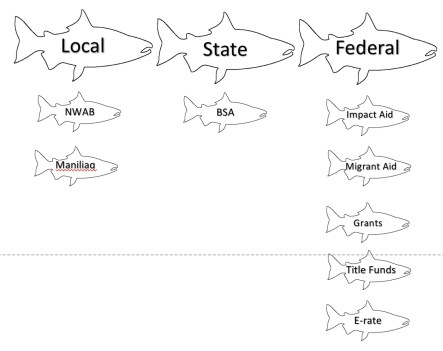
The Northwest Arctic Borough School District’s funding sources are broken down into three areas: local, state, and federal. Each one of these fund locations is made up of many smaller funding sources. For example:


Local Funding Sources  Local funding sources makes up 17% of the overall budget.  Example of these sources are received from the Northwest Arctic Borough and Maniliaq.

State sources

The state of Alaska provides the majority of funding at 62% of the budget.  These sources of revenue are: basic student allocation, boarding home stipend,  and grants.

Federal Sources

Federal sources of revenue consists of 21% of the budget. Competitive grants, E-Rate, Impact, and Migrant aid.  The diagram above represents the current, major funding sources for the school district.

Please stay tuned – the next blog post will be highlighting funding levels and how the are calculated.

We encourage our stakeholder to attend and be part of our budget committee meetings.  This committee meeting takes place the last Monday of each month.  Budget items and future trends are discussed.


Acronyms & Explanations

ATC – Alaska Technical Center vocational center for adult and high school students.  Course offerings in following areas: Process Technology, Healthcare, Culinary Arts, Construction, and Business.

BSA – Basic Student Allocation

E-Rate – provides discounts for telecommunications, Internet access and internal connections to eligible schools and libraries.

Impact Aid – assist United States local school districts that have lost property tax revenue due to the presence of tax-exempt Federal property, or that have experienced increased expenditures due to the enrollment of federally connected children, including children living on Indian lands

Migrant Aid- Grant programs that provide academic and supportive services to the children of families who migrate to find work in the agricultural and fishing industries.